

Understanding all the drone rules can feel like navigating a jungle, but rest assured, the basics are actually quite simple. For the vast majority of drones with cameras, it comes down to two things: you must register as an operator with the Swedish Transport Agency (Transportstyrelsen) and often also obtain a drone license online. The specific requirements for you depend on your drone's weight and how you plan to fly.
A quick overview of Sweden's drone regulations
Flying drones in Sweden has exploded in popularity, but with that freedom comes great responsibility. The regulatory framework exists for a reason – to guarantee safety in the air and protect both people on the ground and other air traffic. The core is simple: as a pilot, you must always be aware of the rules that apply to your specific drone and the flight you intend to perform.
Modern regulations, which are common across the EU, have created a more predictable and uniform playing field. A major shift is the current focus on the risk of a flight, rather than just whether you are flying for fun or for work. A heavy drone near people is obviously a higher risk than a small lightweight one in an open field, and that is exactly what the rules reflect.
The three operational categories
To make everything easier to grasp, flights are divided into three main categories. For most hobbyists and many professional users, the Open category applies. This covers low-risk flights and has the simplest requirements.
Here is a quick breakdown:
- Open category: For low-risk flights. You must always maintain visual contact with your drone (VLOS), stay below 120 meters in altitude, and avoid flying over crowds of people.
- Specific category: For medium-risk flights, such as flying beyond visual line of sight (BVLOS) or near people. This requires a specific permit from the Swedish Transport Agency.
- Certified category: For very high-risk flights, e.g., transporting people or dangerous goods. Here, the requirements are as strict as those for manned aviation.
The rules are not static; they are constantly evolving. A clear example is how the Swedish Transport Agency adapted the rules for socially important missions. In 2022, a new regulatory framework was introduced that allowed the Swedish Sea Rescue Society (Sjöräddningssällskapet) to become the first organization in Sweden to receive a permit to fly drones beyond visual line of sight. This has completely transformed their capabilities during maritime rescue operations.
Here is a table summarizing the most important points for a quick overview.
Summary of drone categories and requirements
| Category | Type of flight | Pilot requirements | Example use cases |
|---|---|---|---|
| Open | Low risk, within sight (VLOS), max 120m altitude. | Operator registration, drone license (usually A1/A3). | Hobby photography, basic inspections, landscape filming. |
| Specific | Medium risk, e.g., beyond visual line of sight (BVLOS). | Requires operational permit from the Transport Agency, often more advanced training. | Package deliveries, advanced infrastructure inspections, rescue operations. |
| Certified | High risk, similar to manned air traffic. | Extensive certification of both drone and pilot. | Passenger transport (future air taxis), transport of dangerous goods. |
The table provides a good starting point for understanding which category your flight likely falls into.
Understanding these basic principles is your first and most important step. With the right knowledge, you can enjoy your drone in a safe and legal manner.
Understanding the new EU regulations and C-classes
Flying drones has become easier and safer thanks to the common EU regulatory framework. Previously, it could be a jungle of different rules depending on whether you flew for pleasure or for work. Now, the risk of the flight determines what applies instead.
The idea is simple: a small, light drone poses less risk than a large and heavy one. Therefore, a system has been created that focuses on the drone's weight and where you plan to fly. Best of all? The rules are the same throughout the EU. This means you can pack your drone for a holiday in Spain and fly according to the same principles as at home in Sweden.
C-classes explained as weight classes
To make it crystal clear which drone belongs to which risk category, the C-classification was introduced, spanning from C0 to C4. Think of it like weight classes in boxing – a lightweight (C0) has fewer restrictions, while a heavyweight (C4) requires more from you as a pilot.
You can find this labeling directly on the drone and its packaging. This makes it super easy to know right in the store which rules will apply to the specific model you are considering buying.
The C-classification is the key to everything. It links the drone's technical characteristics with the rules you must follow. A C0 drone is built to be so safe it can be flown near people, while a heavier drone requires you to maintain a significant safety distance.
Knowing your drone's C-class is essential. It dictates everything from whether you need a drone license to how close to residential areas you can fly.
The image from the Swedish Transport Agency below provides a good overview of how it all connects. Most hobbyists stay within the "Open category," where the C-classes are the foundation.
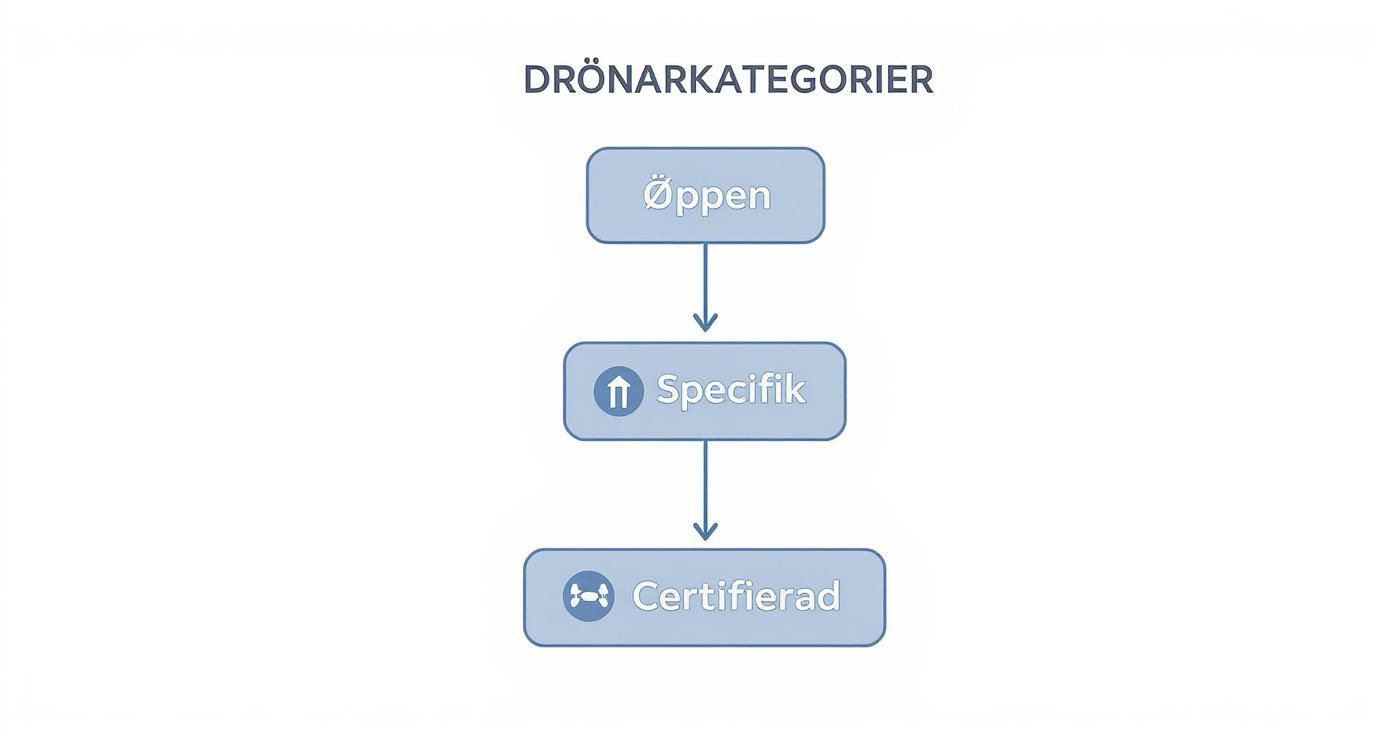
As you can see, the system is divided into three main categories: Open, Specific, and Certified. For most people, the rules in the Open category are the relevant ones.
The most common C-classes in practice
For those flying in their spare time or capturing images for social media, categories C0 to C2 are the ones you will most likely encounter. Let's look at what they mean in practice.
- C0-class: This includes the smallest drones weighing a maximum of 249 grams. Think light beginner models or "toy drones." You don't need a drone license, but if it has a camera, you must register as an operator. The best part is that you can fly over individual people (but never over crowds).
- C1-class: Here we find many popular hobby drones weighing up to 899 grams. For these, you must obtain the basic A1/A3 drone license online. The rule is simple: avoid intentionally flying over people you don't know.
- C2-class: Drones in this class weigh up to 4 kg and are often more advanced. Here, the requirements are stricter. You must maintain a safety distance of at least 30 meters horizontally from uninvolved persons and need to obtain both the A1/A3 and the more advanced A2 drone license.
Comparison of drone classes (C0-C4)
To provide an even clearer picture of how the different classes differ, we have put together a simple comparison table. This helps you quickly see what applies to each class, from the lightest to the heavier models.
| C-class | Max weight | License requirement | Typical flight zones | Example drones |
|---|---|---|---|---|
| C0 | Under 250 g | No (but operator reg.) | Near people (not crowds) | DJI Mini series |
| C1 | Under 900 g | Yes, A1/A3 | Areas with few people | DJI Air series |
| C2 | Under 4 kg | Yes, A1/A3 + A2 | Keep 30 m distance from people | DJI Mavic 3 Pro |
| C3 | Under 25 kg | Yes, A1/A3 | Far from people (A3 rules) | Larger professional drones |
| C4 | Under 25 kg | Yes, A1/A3 | Far from people (A3 rules) | Model aircraft, custom builds |
This table clearly shows how requirements increase with the drone's weight and potential to cause harm. A C0 drone is easy to get started with, while a C2 drone requires more responsibility and knowledge from you as a pilot.
Are you looking for your first or next drone? It might be smart to choose a model that fits your ambitions. Check out our guide on the best drones for different budgets to find the perfect one for you.
What applies to older drones without C-marking?
What happens to all the drones sold before the new rules came into force? Don't worry, you can still fly them. These are called "legacy drones" and follow specific transitional rules based entirely on their weight.
Here is what applies:
- Weight under 250 g: Can be flown just like a C0 drone in subcategory A1 (near people, but not over crowds).
- Weight between 250 g and 25 kg: May only be flown in subcategory A3. This is the big difference – you must maintain a safety distance of at least 150 meters from residential, industrial, and recreational areas.
If you have an older, heavier drone without C-marking, it is extra important to plan your flights. You must find open spaces far away from people and buildings to fly legally and safely.
How to get your drone license and operator ID – step by step
Getting the right credentials to fly a drone can seem like a jungle of rules, but it's actually easier than you think. Think of it as getting a driver's license for the sky – a digital one. Before you can take off with most camera-equipped drones, you need two things: an operator ID and a drone license.
Think of the operator ID as the drone's license plate. It's a unique code you attach to the drone so it can always be identified. The drone license is your personal proof that you know the rules and how to fly safely.
Everything is handled smoothly via the Swedish Transport Agency's drone portal. The entire process is digital, from registration to the exam. Let's go through how to do it, step by step.
Step 1: Register as an operator
The very first thing you must do is register as a drone operator. This is a legal requirement for virtually everyone flying a drone with a camera, regardless of weight. Yes, that even applies if you're just flying a small DJI Mini weighing under 250 grams.
You can register quickly on the Swedish Transport Agency's website. Have your BankID ready and be prepared to pay a small annual fee. As soon as that's done, you'll receive your unique operator ID.
Your operator ID is more than just a combination of numbers – it is your direct link to the drone. Label your drone clearly with the ID before you fly. Should anything happen, authorities can quickly see who the responsible owner is.
Once the ID is set, it's time for the next step: the training leading to your drone license.
Step 2: Take the online training and exam
For most hobbyists and semi-professionals, the A1/A3 drone license is what you need. This license authorizes you to fly the most common C-classed drones (C0-C4) and covers all the fundamental knowledge you need.
Both the training and the exam are free and conducted online. The material is divided into simple modules covering everything from aviation rules and privacy issues to pure flight safety.
- Study: Take the time to go through the training material on the Transport Agency's portal. It is pedagogically structured and provides everything you need to pass the exam without problems.
- Take the test: The exam consists of 40 multiple-choice questions. To pass, you must answer at least 75% of them correctly. No panic if you don't pass immediately – you can retake the test several times.
- Download your license: Once you've passed, you can download your digital drone license instantly. Save it to your phone so you always have it handy if anyone asks for it.
Are you brand new to the world of drones? Then we recommend our guide on drones for beginners, where we cover everything you need to know before your first purchase and flight.
Do I need an A2 license?
For those aiming to fly heavier drones (in the C2 class) closer to people, a more advanced drone license is required: A2. This license sets higher standards and builds upon the knowledge from A1/A3.
The process for the A2 license is a bit more extensive:
- Passed A1/A3 exam: You must first have passed the basic exam.
- Practical training: You need to complete practical flight training on your own in a safe area to prove you master your drone.
- Theory exam at the Transport Agency: Finally, you must pass a more in-depth theory exam conducted on-site at the Swedish Transport Agency, which involves a fee.
The A2 license opens more doors but also demands more from you as a pilot. For most people, however, the A1/A3 license is more than enough to enjoy their hobby safely and legally. By following the steps above, you're ready for an amazing flying experience.
Finding the right flight zones and avoiding prohibited areas
Getting a drone license and an operator ID is a bit like getting a driver's license and registering your car. You have your paperwork in order, but that doesn't mean you can drive anywhere you want. The airspace, just like the road network, is full of invisible boundaries and rules. Knowing where you can fly is just as important as knowing how.
Two golden rules stand out. First, you are almost never allowed to fly higher than 120 meters above the ground. This limit is a safety buffer to keep drones well away from manned air traffic like airplanes and helicopters. Second, you must always maintain visual contact with the drone – a concept called VLOS (Visual Line of Sight). This means you should be able to see it with the naked eye, without using binoculars.
Interpret the drone map like a pro
To navigate this complex airspace, LFV's (the Swedish Civil Aviation Administration) official drone map is your most vital tool. Think of it as your GPS for the air. The map clearly shows where restrictions exist, from permanent protected areas to temporary flight bans.
Here are some of the most common zones you will encounter:
- Control Zones (CTR): These are areas around airports where air traffic control manages everything. Flying here as a hobbyist is generally prohibited and almost always requires special permission.
- Restricted Areas (R-areas): These protect sensitive locations such as nuclear power plants, prisons, and military facilities. Total flight bans usually apply here.
- Natural Areas: Many national parks and nature reserves have rules to protect wildlife. Always check with the County Administrative Board (Länsstyrelsen) regarding what applies in the specific area you plan to visit.
The rules aren't there to throw a wrench in our works, but to manage an increasingly crowded airspace. In Sweden today, there are an estimated 500,000 civilian drones, and that number is growing steadily. With so many drones in the air, it's vital that everyone follows the same ground rules to avoid accidents. Feel free to read more about the development and regulation of drone traffic in Sweden.
The LFV drone map is a living tool that is constantly updated to reflect the latest restrictions.
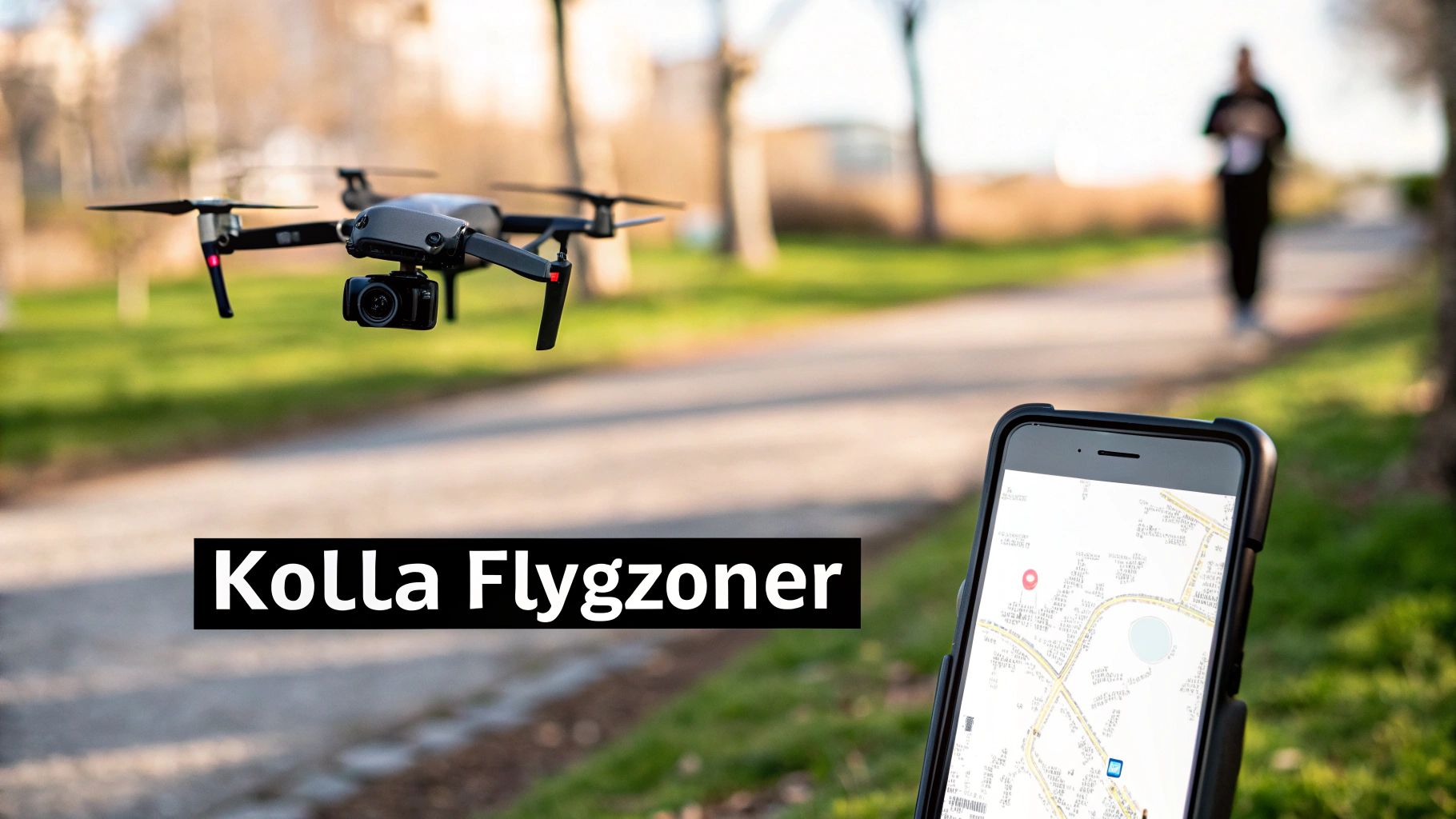
The map is intelligently designed with color codes making it incredibly easy to quickly see if an area is clear or if there are limitations.
Plan your flight for maximum safety
A responsible pilot always plans their flight in advance. It's not just about finding a beautiful spot to shoot, but also ensuring everything is done correctly and safely. Taking chances can lead to heavy fines at best, and a serious accident at worst.
Checking the drone map before every flight should be as routine as checking your battery level. It only takes a few minutes but can save you a lot of trouble.
Here is a simple checklist to run through before you take off:
- Open the drone map: Visit the LFV map and zoom in on your intended flight location.
- Look for zones: Are there any colored areas? Particularly CTR zones (often around cities) and restricted areas.
- Read the details: Click on the marked zones. This will provide specific info on altitude limits or times when flying is prohibited.
- Use common sense: Even if the map gives a green light, think twice. Avoid flying near crowds, accident scenes, or over events without permission.
Many drones, such as those from DJI, also have built-in systems (geofencing) that warn you in the app if you approach a sensitive area. Sometimes the system can even prevent the drone from flying into a prohibited zone. Treat this as an extra safety net, but remember that the LFV map is the definitive source for Swedish conditions.
Respecting airspace boundaries is essential for any serious drone pilot. By using available tools and always planning ahead, you not only ensure your own and others' safety – you also help build a good reputation for the entire drone hobby.
Insurance requirements and your responsibility as a pilot
Owning a drone is fantastic, but it comes with significant responsibility. From the second your drone takes off, you as the pilot bear full responsibility for everything it does. If something goes wrong, you are the one held accountable for damage to property or, in the worst case, people.
Imagine flying in a park on an ordinary day. Suddenly, the signal drops, the drone loses altitude and lands on a parked car. The result? A dent and nasty scratches in the paint. Without insurance, such a minor mishap can quickly become an expensive story with repair costs running high.
This example illustrates one of the most important parts of drone rules: your strict liability. Legally speaking, this means you can be held liable for damage your drone causes, even if you weren't negligent.
When is insurance a legal requirement?
For many drone pilots, insurance isn't a choice; it's a must. EU rules are crystal clear on this point.
Liability insurance is mandatory for all drones weighing 20 kg or more. But it doesn't stop there. The requirement also applies to all drones, regardless of weight, flown in the Specific or Certified categories – where risks are higher.
For most people flying in the Open category with drones under 20 kg, there is no legal requirement. However, it is an incredibly strong recommendation. The costs of an accident can be astronomical, and good insurance is the only sensible safety net you can have.
Flying uninsured is like driving a car without third-party liability insurance – an economic gamble you really don't want to take. If your drone were to cause serious personal injury, damages could reach hundreds of thousands, or even millions, of kronor.
Getting insurance is not an unnecessary expense. Consider it a smart investment in your and others' safety.
How to choose the right drone insurance
When you start looking for insurance, you'll quickly notice there's a plethora of options. Some home insurance policies may offer some basic protection, but it's rarely enough. Often, you need a specific add-on or a completely separate drone insurance policy to be safe.
Here are a few things you should look at closely when comparing:
- Liability Insurance: The most critical part. It covers damages your drone causes to other people or their property. Ensure the coverage amount is high enough to cover even serious accidents.
- Accidental Damage Insurance (All-risk): This covers damage to your own drone if you happen to crash. An invaluable addition, especially if you've invested in expensive equipment.
- Area of Validity: Check where the insurance applies. Does it only cover flights in Sweden, or do you have protection throughout the EU?
- Policy Exclusions: Always read the fine print. Are there exceptions for flying in the dark, over water, or for commercial use? Ensure the coverage matches how you actually use your drone.
One last pro tip is to always document your flights. Save flight logs from the app – it's an easy way to show you've acted responsibly. If an accident occurs, that documentation could be worth its weight in gold when dealing with the insurance company.
Rules for photo, video, and commercial use
Capturing magical views from above with a drone is an incredible feeling. But as soon as you start using the images or films, whether it's for a job or just for your social media, two new sets of regulations come into play: personal privacy and dissemination permits.
This is about finding a balance. Your creative freedom must coexist with people's right to privacy and Sweden's security interests. By understanding the rules, you can work safely and professionally, whether you're a real estate agent photographing houses, an inspector documenting a facility, or just want to share beautiful aerial films.
Respect personal privacy (GDPR)
Think of your drone as a flying camera. With it comes a great responsibility. If you film or photograph such that a person can be identified – via their face, a license plate, or anything else unique – you are handling personal data. That's when the General Data Protection Regulation, better known as GDPR, comes into the picture.
The basic principle is fairly simple: you must have a legal basis for filming identifiable individuals. The most common way is to obtain the person's consent, but running around asking everyone who happens to walk by is rarely practical.
A good rule of thumb is to avoid filming places where people expect privacy. Think private gardens, balconies, or swimming areas. Always ask yourself: "Would I be okay with being filmed here without knowing about it?"
If you're flying for journalistic or artistic purposes, exceptions may apply, but for most others, it's best to be cautious.
When do you need a dissemination permit from Lantmäteriet?
Beyond GDPR, there is another law that is just as important: the law regarding the protection of geographic information. It exists to protect information that could be sensitive to Sweden's defense. Are you planning to publish or share images and videos taken from the air? In most cases, you will need a dissemination permit (spridningstillstånd) from Lantmäteriet (the Swedish Mapping, Cadastral and Land Registration Authority).
It doesn't matter where you publish – on the company website, Instagram, or in a promotional brochure. The requirement still applies. The permit is free to apply for, and for most locations in Sweden, the process is quick and smooth.
As you can see, the application is digital and fairly uncomplicated, but make sure to apply well in advance of when you plan to publish anything.
The rules around aerial photography are closely linked to Swedish defense history. In fact, the Swedish Armed Forces used the reconnaissance drone Ugglan as early as the late 90s. Today, development is moving at a breakneck pace, with explorations into AI for improving military precision. You can read more about the evolution of drones from experiments to necessity here.
Frequently asked questions about flying drones
When diving into drone regulations, it's easy for your head to start spinning. There are many "what ifs" and "is that really allowed?". Here we've gathered some of the most common questions that arise, whether you're brand new or have been flying for a while. The answers are straight and simple, so you can quickly get up to speed.
Do I need a drone license for my small drone under 250 grams?
No, you don't need a drone license if your drone weighs under 250 grams. However, and this is important, if the drone has a camera – which almost all do today – you must still register as an operator with the Swedish Transport Agency.
It's a common misconception that these small drones are completely free from rules. Don't forget that you must always follow the basic flight rules, such as staying away from airports and never flying over crowds.
How high can I fly my drone?
The golden rule is 120 meters above the ground or water. This is the absolute maximum altitude and one of the most important safety rules in existence.
Think of the 120-meter limit as an invisible ceiling. This ceiling keeps your drone separated from manned traffic like airplanes and helicopters. Breaking this rule isn't just foolish; it's dangerous and can lead to very substantial fines.
Should you for any reason need to fly higher, a special permit from the Swedish Transport Agency is required. This is a completely different process with much higher requirements for both you and your equipment.
Am I allowed to fly over other people's houses and property?
This is probably the question that sparks the most discussion. Technically, the airspace is free, but hovering low over a neighbor's yard without asking is rarely a good idea. It can easily be perceived as disturbing and an invasion of privacy.
Furthermore, if you're filming and people are identifiable in the footage, you could be violating GDPR. We have written a complete guide explaining in detail what applies when you want to fly a drone over someone else's property. Common sense and asking first is always the best way forward.
At ActionKing, you'll find everything you need to fly safely and legally, from propellers and filters to bags and spare parts. Explore our vast range of drone accessories at https://actionking.se and take your flight to the next level.


